Home Blog Page 69

The Pérez Art Museum Miami Has A Snazzy New iPhone App

0

The brand-spanking new PAMM App was launched today and has lots of neat stuff, including exhibition audio tours, contextual multimedia content to learn more about the art on display at the museum, unique content related to special exhibitions, and a calendar of the museum’s upcoming events at the Perez Art Museum Miami. The app is beautifully made and pretty fantastic.

Like everything else in the world though, it’s not perfect. It only works on iPhones, iPads, and iPod touches, and they’ve provided what basically amounts to a website duplicate for everyone else, at pamm.org/app. Sure that means you don’t need the app at all if for some reason you don’t want it, but apps always provide a more seamless experience. Even worse, the app unnecessarily turns your music off when you open it, which is just so annoying. Still, those two relatively minor annoyances aside, it really makes you wish more Miami institutions would get App-y. Here’s the press release for more deets:

MIAMI – May 5, 2017 – Pérez Art Museum Miami (PAMM) today launched a mobile app, powered by Cuseum, to enhance the museum-going experience for its visitors. The PAMM app gives users an opportunity to experience, learn and engage with the art on view at PAMM by providing contextual multi-media content, including audio tours and videos of the interior and exterior galleries, an interactive map, and a calendar of museum events and programs. The app also offers unique content related to PAMM’s special exhibitions. For PAMM’s current exhibition, Toba Khedoori, the app offers exclusive audio interviews with PAMM Director Franklin Sirmans, the exhibition’s curator, that address the artist’s silent, slow and exacting process of working by hand.

“Art and technology have always been intertwined,” said Sirmans. “With technology always rapidly changing, we are looking to evolve the museum-going experience with our visitors’ wants and needs. This app is next step in our evolving relationship to technology and its application to the museum experience.”

The PAMM app is part of a six-month pilot with Cuseum, a leader in the mobile app space for art museums and cultural organizations.

“We’re excited to be partnering with Pérez Art Museum Miami, one of the most innovative contemporary art museums in the country,” said Brendan Ciecko, CEO & founder of Cuseum. “PAMM’s commitment to engaging and connecting with their audience through new digital channels is inspiring – we’re honored to support these initiatives with the new PAMM mobile app.”

The mobile app also supports PAMM’s wide range of interpretation needs and is a key tool for video storytelling, putting rich and unique content into the palm of visitors’ hands. With artist interviews and videos produced by the museum’s on-staff digital journalist – a newly established position at PAMM that seeks to leverage video content to amplify PAMM’s art, mission and programs – the app is the first in a series of upcoming tech initiatives launching at the museum. Later this month, PAMM will announce a new pilot program funded by the museum’s close partners at the John S. and James L. Knight Foundation, focused on in the intersection of art and augmented reality.

The launch of PAMM app has been part of a broader conversation with the Knight Foundation on how to incporate technology into the museum to connect people to art, enhance the visitor experience and advance scholarship.

“Art museums have a unique role in telling our stories, reflecting our cultures and helping us understand the world around us. To remain relevant, they have to adapt to the way people live today,” said Victoria Rogers, vice president for arts at Knight Foundation. “We hope to help museums accelerate that process and use digital tools to meaningfully engage visitors in high-quality art.”

The PAMM app is available for free from the App Store on iPhone, iPad and iPod touch, or on all devices at pamm.org/app.

Inside the New Science Museum; Tommy Hilfiger’s New Digs; A $5M Half-Built Mansion

0

Thursday was one looooong day, and here’s the news:

The Owner of the Office in the Grove, Designed by Ken Treister, is Mast Capital

1

Rumor is they want to demolish or sell it.

As you know from previous Big Bubble coverage, the modernist Office in the Grove by architect Kenneth Treister is supposedly facing demolition in the hands of its current owner, the previously unnamed developer Mast Capital. The striking lobby has already been destroyed. The company’s name is hidden behind an LLC, and the owner of that LLC is listed as another company which according to its website commonly acts as “agent.” Basically it’s a frontman. All these somersaults give the appearance that Mast, a prominent South Florida developer is trying to hide its tracks, and yet apparently they’re not hiding it all that much because the building is publicly listed on Mast’s own website. So, there’s that.

Screen Shot 2017-05-03 at 6.09.23 PM.png

No Casinos in Miami Beach; New Park Amenities for Viriginia Key

2

Happy Hump Day:

Original Bas-Reliefs Lining Lobby of Architect Ken Treister’s ‘Office in the Grove’ Destroyed by Developer

1

The developer who recently purchased the Office in the Grove building, designed and constructed in 1970 by important local architect Kenneth Treister, appears to be very serious about his or her intentions to demolish it, and has already destroyed the original lobby.

Strong and obvious steps have been taken to destroy as much of the tower’s architectural significance as possible before preservationists and city preservation department staff attempt or have any power to get in his or her way. This developer, whose name is hidden behind an anonymous LLC, has destroyed the lobby’s architectural bas reliefs, which evoked the beauty and the eclectic spirit of old Coconut Grove, and replaced them with absolutely blah white walls. Original light fixtures have disappeared as well.

get-attachment-3.aspx.jpgKT early work and furniture 8-27-07 065.jpg3977-02 c2010 Dan Forer.jpg

Office In The Grove
Photo by Dan Forer.

A Hike Down In Villa Vizcaya’s Mysterious Jungle Moat

0

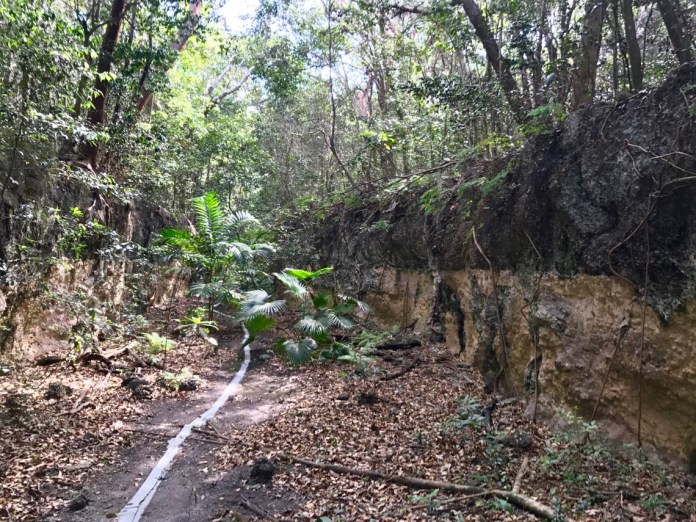
Vizcaya, the early 20th century winter home of Chicago industrialist James Deering was almost from its earliest inception destined to be far more than just a big house in Coconut Grove, despite Deering’s desire for a comfortable and pleasant place to spend the winters and entertain relatives in his retirement. As soon as Deering met Vizcaya’s chief designer, or ‘creative director’ as he is also known, Paul Chalfin, the estate became a great gestamkunstverk, or total work of art.

Although the beating heart of Vizcaya—the house, the formal gardens, the barge, the hammock, the village, etc.—has been preserved, almost as much of the estate has been lost to time, or at least overlooked and almost forgotten. That includes the moat, a deep ditch following the path of Brickell Avenue, which originally cut through the estate. When the road was relocated to give the house more breathing room, the route of the old road was used as a stone quarry for the property, and then, with connections to Biscayne Bay at either end, less successfully, as a moat. Unfortunately it was too high up on Coconut Grove’s long limestone ridge, and, in the unusual instance of something in Miami being too far above the water line, whatever water they kept pumping in would rapidly drain through the porous stone and right out. So, empty and an almost forgotten piece of Vizcayana, it remained.

The moat still exists luckily, and is the setting for a few pieces of contemporary art exploring the lost spaces of this incredible, historic estate.

gardenplan
The moat can be seen near the top of this map, in a near straight line passing under the bridge. of the main estate entrance and terminating at a lake which is now lost.

IMG_3079IMG_3081IMG_3084IMG_3085IMG_3086IMG_3094IMG_3099IMG_3107IMG_3111IMG_3120IMG_3123IMG_3126IMG_3131IMG_3134IMG_3135IMG_3138IMG_3143IMG_3144IMG_3152IMG_3153IMG_4216IMG_4195IMG_4192IMG_4191IMG_4213IMG_4213 (1).jpgIMG_4212Version 2

Construction Progresses on Española Way Improvements, Finally

0

After who-the-hell-knows-how-long of nothing happening to the torn up Espanola Way, one of Miami Beach’s most iconic architectural compositions, things have finally begun moving forward with its conversion to a completely pedestrian environment.

Espanola Way is a narrow and quaint street slipping its way about six or seven blocks through South Beach’s historic Miami Beach Architectural District, but it’s also a block and a half long unified Mediterranean Revival architectural composition. Known technically as the ‘Spanish Village’ or ‘Old Spanish Village,’ this part was originally built in the booming 1920s by N. B. T. Roney (short for Newton Baker Tylor Roney), the man who built the famed and long-gone Roney Plaza hotel around the same time. The Roney was located where the 1 Hotel & Homes is now, not too far away.

Anywho, now that the history lesson’s over, back to business. We originally wrote about the pedestrianization of the Spanish Village section of Espanola back in October, when The Big Bubble was still called Sean of Miami, and construction fencing surrounded the block. It took the City of Miami Beach months and months to really begin work though, ripping the asphalt street bed out, and then basically doing nothing, with construction stalling and the road being in shambles straight through the middle of the tourist season. In March we pointed that mess out.

On top of that, one of the Spanish Village’s colonnades was even damaged and just left unchecked until very recently, when BOOM, the city finally concreted over the whole block. And that’s where we are now. It’s definitely not done. The paving down the center of the road is obviously incomplete, and the sidewalks need work, probably including painting, too. But at least we’re no longer trudging down a dirt road, or now that the rainy season is starting, a muddy one. Oh and that lovely historic colonnade has been repaired as well.

IMG_2942