Home Blog Page 67

‘Florida Architecture’ Praised the Office in the Grove When it Was Brand New.

0
The Office in the Grove.

OFFICE IN THE GROVE

KENNTH TRIESTER, FAIA. John B. Ross & Associates, Engineers. Robert Turchin, Contractor. Text from Florida Architecture, 40th Anniversary Edition.

A building that is integrated with landscape and art: an office structure that is completely humanized, and architectural design which was dictated by the unusual site and the desire to give maximum views of the tropical environment: That is Office in the Grove. The building concept developed by Kenneth Treister, FAIA in 1970, offers a contemporary structure delightfully in scale with its environment and the people who make use of its facilities on a daily basis. Integrating art, architecture and landscape into a harmonious whole is an achievement, which will distinguish the building as a landmark for future generations to enjoy.

The location on South Bayshore Drive in Coconut Grove, overlooking Miami’s Dinner Key Marina and sailboat anchorage determined the total feeling and character of the building. Its pentagonal shape, on a triangular site, provides office views of the park, Biscayne Bay and the hundreds of picturesque sailboats at anchor.

Office In The Grove
Photo by Dan Forer. Architect, Kenneth Treister

The eight-story structure has a giant wedge, which seems to be cut out from the whole. This wedge is a key ingredient in the design, distinguishing as it does, the main entrance to the building. It serves also to enclose a dramatic shaft of vertical space, which may be seen upon entering the lobby. From a practical standpoint, the wedge circulates fresh air to the smoke-proof fire tower, allowing for the circular core design. The entire facade is composed of tinted glass windows to offer maximum views. Each window in recessed into pre-cast concrete panels, which serve to shade the glass, protecting the glass in case of storm. Artistically, it creates deep shadows on the façade, which give interest and movement as the sun travels its course.

The South Bayshore Drive entrance is prominent to behold and has immediate identification. This was accomplishes through the use of a canopy of steel and glass, serving both as a sculptural accent and as a cover for cars to disembark passengers. In his effort to humanize the Office in the Grove, the architect-artist has eliminated the automobile from pedestrian view. This allows the environment to become in scale with man and his place, instead of the car and its pace.

The solution was to avoid building a huge parking structure. Instead, automobiles were submerged in parking areas beneath the structure, hidden in a large pedestal base upon which the superstructure rests. There are three levels of parking, each approached by a different entry and level, taking advantage of the extreme differentials in levels of the site and adjacent streets, Bayshore Drive and 27th Avenue. The tri-level base is: a basement level, a second level concealed by a grass berm exterior and the third level under the main structure, hidden by a continuous fern planter wall which caps the grass berm. The berm not only gives the building a base, but also provides a low, natural and green silhouette to the passing pedestrian or motorist. The superstructure with it eight floors of shaped office space surrounding the central core, gives the building great efficiency with a minimum of interior hall spaces.

kt-early-work-and-furniture-8-27-07-065

The lobby is deliberately small and in human scale to accommodate pedestrians who enter in small numbers. It is two stories high, exposing a balcony, with integrated art, both on the exterior and the interior. The theme of the art in various media is the lush tropical vegetation of southern Florida.

The art takes many forms: pre-cast concrete sculpture, bronze sculpture and Honduras mahogany carvings. The exterior exposed concrete façade features tropical fauna and flora, utilizing the sun as a changing tool to give movement and interest to the designs. The theme is repeated in the lobby and on each floor, giving visual and aesthetic identity to the individual floor and for its occupants and visitors.

Each sculpture is an original work of art and cannot be repeated because the molds are lost with each pouring. The architectural buff will further note on close inspection, that the exposed concrete of the exterior has broken fines, which also catch the sun as it moves.

Office in the Grove
Photo by Dan Forer.

The bronze sculptures of Office in the Grove appear first in the large sculpture of birds nesting on a fountain at the main entrance. The bronze sculptured doors of the elevators, the chandeliers on the lobby and the bronze bas-relief over the entry door are fine examples of this medium. The Honduras mahogany carved entrance door reflects the architect’s love affair with art also. Again the carvings illustrate the tropical environment and are executed in each of the elevator cabs.

A 16-foot high mural in the lobby depicts a tropical landscape and curves with the wall, becoming an integral part of the architecture.

On each floor, al large photomural features a different scene of Coconut Grove, in sepia tones to blend with the beige and brown color theme of the building.

Landscaping is lush, of course, showing a maximum of greenery and therefore, humanizing the total structure. Planters have been placed at the parking level, the top 9th floor balcony and along the roof’s perimeter, crating a natural organic, living felling. Essence of the design is that art, landscape and architecture are inter-related with man and his environment.

One could only hope that more architectural concepts make art and landscape an integral part of the architecture serving man.

Office in the Grove
Photo by Dan Forer.

Gemini Estate Drops Price by $30 Million; Havana Getting its First Five Star Hotel Since the Revolution

0

Lots of real estate news for this Monday update:

IMG_7962

Instagramer Menchee Creates Immersive Abstractions Out of Miami’s Architecture

0

Instagram user Michael Menchero, who goes by the tag Menchee, has shot many of Miami’s best and lesser known works architecture to create incredibly immersive abstract stills and videos. Not always easily recognizable as buildings in Miami, or even buildings at all, trying to identify which condo tower, hotel, or office building each one is can be pretty entertaining. Menchero never identifies the structures, but he does at least say what city they’re in (which is helpful because his work goes beyond Miami). And sometimes he throws a subtle little joke in, like making one particularly luxurious condo blast off into space. Below is a selection of really just a few of his best works, while many, many more are on Instagram.


The Brand Spankin’ New CocoWalk; Miami Beach Gets a Military-Grade Armored Truck, Just in Time for Urban Beach Week. Yep

0

News, news, glorious real estate news:

IMG_7097

Construction of Brightline’s Massive Downtown Miami Station Thundering Ahead

0

The massive train station called MiamiCenral that will be the Downtown Miami terminus of the Florida East Coast Railway’s Brightline (formerly known as All Aboard Florida) is taking shape on a long strand of city blocks stretching north from the Dade County Courthouse.

Lately there has been some controversy over what is being called the Great Wall of Overtown, which more specifically is a solid ramp that will raise the railroad tracks up to the level of the station’s elevated platforms. Although it doesn’t block any existing roadways, the ramp has however proven to be somewhat of a physical and visual barrier between the historically black neighborhood of Overtown to the west and the soon-to-be redeveloped Park West district to the east.

The FEC is also developing a mixed-use block of land, considered to be a part of the MiamiCentral station development within Overtown, that will contain a Publix grocery store, parking, and other amenities, but that is located to the south of the wall. Many Overtown residents, who have historically been the victims of massive transportation projects throughout Miami’s history, are understandably not happy. For one thing, I-95 was a big ‘fuck you’ to the neighborhood when it was built in the decades following WWII. However, Overtown has always been ‘over the tracks,’ but now it just might be ‘over the wall’ too.

South of the wall, construction is looking much more beautiful, and much less controversial. Designed by national firm Skidmore, Owings & Merrill, and local firm Zyscovich, the combination Brightline and Tri-Rail station and its associated development will be nothing if not grand, with skyscrapers sprouting above a long concourse and shopping development, itself elevated above ground and offering spectacular views of Miami’s skyline. Elevated Metromover and Metrorail lines will wind through the structure while ground level pedestrian and automotive traffic will circulate underneath. The whole thing will be a hive of movement and activity.

Photos by Sean McCaughan.

The Office in the Grove Will Be Considered for Miami Historic Designation on September 5th

0
Photo by Dan Forer.

PRESERVATION GROUPS TO ASK CITY OF MIAMI TO DESIGNATE COCONUT GROVE OFFICE BUILDING HISTORIC

Kenneth Treister FAIA – Designed Iconic ‘Office in the Grove’ in 1973,

Unique Example of Mid-Century Architecture

May 9, 2017 (MIAMI) – Docomomo US / Florida, the local chapter of Docomomo International, a non-profit organization dedicated to the documentation and conservation of buildings, sites and neighborhoods of the modern movement for nearly 25 years, applied May 5 to the City of Miami Historic and Environmental Preservation Board requesting them to designate Office in the Grove, Coconut Grove, a historic, architectural resource.

The iconic, mid-century building designed in 1973 by Kenneth Treister, is located at 2699 S. Bayshore Drive in Coconut Grove. It is one of the few remaining examples of the renowned architect’s work and would be a grave loss to Miami’s slim architectural history.

The Dade Heritage Trust, whose mission is to preserve Miami-Dade County’s architectural, environmental and cultural heritage, recently placed Office in the Grove on its list of most endangered sites.

This item will be heard at the City of Miami Historic and Environmental Preservation Board Hearing on Tuesday, September 5th. Hearing starts at 3 p.m. at Miami City Hall, 3500 Pan American Dr., Miami, FL 33133.

In its application, Docomomo US cited the following reasons for preserving the building:

  • UNIQUE EXAMPLE OF MID-CENTURY ARCHITECTURE

Built almost 50 years ago, this is an award-winning outstanding example of Mid-century architecture in South Florida that should be preserved. Sited on tall green berms overlooking the intersection of 27th Avenue and South Bayshore Drive, the elegant Office in the Grove tower marked an important step in the evolution of Coconut Grove. Its compact form set amid greenery and art meshes business culture with the Grove’s relaxed lifestyle and historical landmarks.

  • INNOVATION – A LANDSCAPE BERM… PEDESTRIAN FRIENDLY

Office in the Grove is an eight-story hexagon tower floating over a three-level, grass-landscaped pedestal. This was Miami’s first office building to give the community an eye-level, landscaped grass berm as its facade.

  • INNOVATION — NO SURFACE PARKING LOT                           

Office in the Grove is placed with maximal views of Biscayne Bay with ample parking yet without the traditional and often distasteful asphalt or concrete parking lot. Instead, the parking is hidden behind environmentally friendly levels: one below ground, cut into the coral rock ridge (a first); a second is hidden behind a broad, sloping grass berm (a first); and the third, parking is nestled in the shade under the tower’s raised stilts concealed by battered concrete decorative, fern planters (a first);

  • INTEGRATION OF LANDSCAPE & ARCHITECTURE

The landscaping is not a decorative add-on but part of the architectural design. The form, shape and slope of the grass berm is part of the building’s architectural form; it mirrors the concrete battered walls and below the triangular concrete, fern planters. The tall Royal Palms on 27th Ave. and the building’s point, all planted in 1970, are part of the original architecture.

  • INTEGRATION OF ARCHITECTURE & ART

Office in the Grove is resplendent with integral ornamentation, the theme – the Everglades, casted directly into the pedestal’s concrete base and also in the small, personal lobby (this was the first time carved Styrofoam was used to replicated hand carved stone).

  • INNOVATED METHODS OF CONSTRUCTION

Office in the Grove was one of the first to use post-tensioned concrete slabs & a completely prefabricated concrete façade.

  • ADAPTATION TO SOUTH FLORIDA ENVIRONMENT

The façade is completed shaded and protected from storm by a precast grill, with maximum bay views. In addition, its central core opens to the bay by a wedge “V” cut into the building that brings light and views to each elevator foyer. The offices, placed around this core, do not need the traditional long office corridors.

ABOUT THE ARCHITECT:

Architect Kenneth Treister, FAIA, born 1930, is an internationally known architect and author of ten books on architecture; Fellow in the American Institute of Architects; awarded the Gold Medal from the American Institute of America, Florida, their highest honor; and the Silver Metal and Lifetime Achievement Award, AIA, Miami. Office in the Grove is considered one of Treister’s finest and most important works of architecture.

OFFICE IN THE GROVE AWARDS & PUBLICATIONS

  • Building of the Year Beautification Award from the City of Miami’s Beautification Committee, E. Albert Pallot, Chairman, 1973Archived at the Smather’s Library, University of Florida, Gainesville.
  • Archived at the Pratt Institute School of Design, New York.
  • Featured in the 40th Anniversary Edition of Florida Architecture, 1973.
  • Featured in a book of South Florida’s most important Mid-century buildings: Miami Architecture: An AIA Guide Featuring Downtown, the Beaches, and Coconut Grove, by Allan T. Shulman, Randall C. Robinson Jr., & James F. Donnelly.


Photo by Dan Forer.

A Photographic Tour of the Office in the Grove’s Art-Filled Lobby Before It Was Destroyed

0

This is the richly decorated, highly sculptural lobby of The Office in the Grove, designed by architect Kenneth Treister in 1970. The building was modernist, but the lobby interior was richly covered in plaster and concrete bas reliefs, copper sculptures and light fixtures, and intricately carved wood elevator panels, depicting many of the natural wonders of the Office in the Grove’s surrounding neighborhood, a place where peacocks walk the streets (Some consider them a public nuisance sadly) and palm trees galore make the name ‘Coconut Grove’ literally true.

The photos are courtesy of Treister himself. Although the building still exists, the lobby was destroyed recently by owner and developer Mast Capital who is likely to oppose the Office in the Grove’s historic designation when it goes before the City of Miami Historic Preservation Board on June 6th. For more on the saga of the Office in the Grove’s preservation, see previous Big Bubble coverage here.

Bal Harbour Shops Expansion Approved; The Hukilau Tiki Festival is Coming; So is El Museo de Little Havana

0

Lots of news this hump day:

IMG_6054

Palm Beach’s $137M Il Palmetto Estate by Iconic Architect Maurice Fatio Is Off The Market

1

It appears that Il Palmetto, one of Palm Beach’s biggest historic estates, which was listed for a whopping $137 million by billionaire Jim Clark, has been taken off the market for the time being.

Although the listing for 1500 South Ocean Boulevard has been removed from the MLS and the rambling estate remains unsold according to Palm Beach County property records, it still appears on the site of its broker Christina Condon of Sotheby’s International Realty. One suspects that means she’s not off the job, and perhaps just giving it a breather during the slow summer season. That way when it pops back on the official market in the fall, it won’t carry the stigma of having sat around unsold for an unseemly amount of time.

Stigma or not, however, it’s an extremely expensive stunner by one of Palm Beach’s most iconic architects, the great Maurice Fatio. The broker’s yadda yadda yadda describes Il Palmetto in detail:

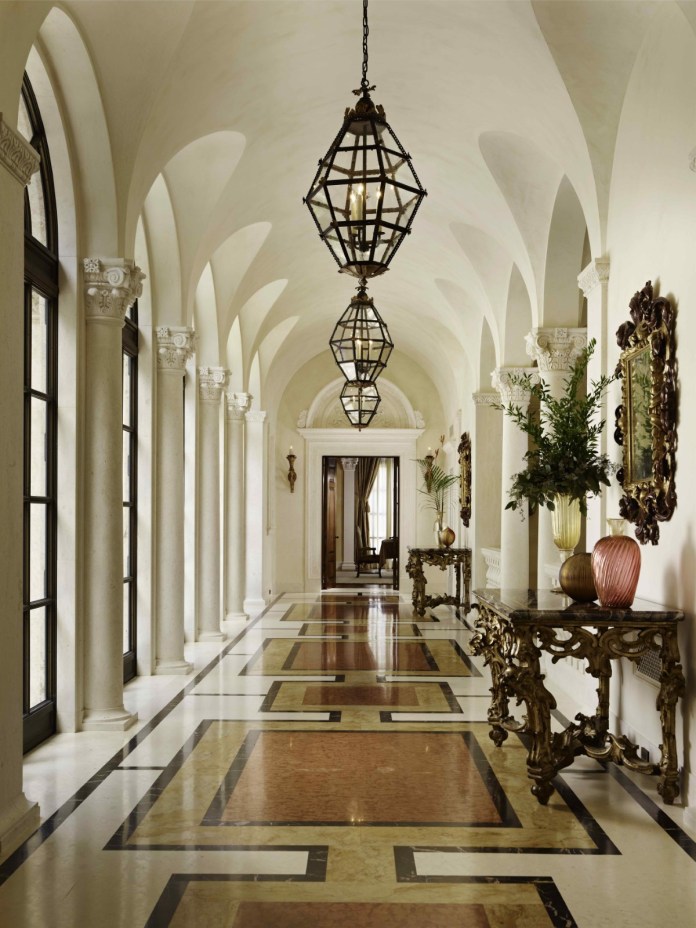
When architect Maurice Fatio was commissioned to build ‘Il Palmetto’ in 1930, the 5.46± acre Ocean-to-Lake estate was declared exceptional. Years later, Fairfax and Sammons oversaw a 4 year meticulous restoration of the Italian Renaissance-style palazzo, Il Palmetto’s architectural detail was maintained. The result is an estate without peer in Palm Beach.

The main residence is designed as a series of pavilions connected by cloisters, beginning with the 2 story entrance hall. The pièce de résistance is the living room with a shield-decorated ceiling and architecturally framed sunset view over Lake Worth. The formal dining room with a 16th Century carved ceiling accommodates elegant dinner parties. The main level is completed by the chef’s kitchen featuring custom appliances, butler’s pantry, family room, theater, billiards room, library, office and pavilion, all circling a courtyard and fountain.

An outdoor loggia connects the inner courtyard to a large swimming pool lined with dark blue tiles. The master bedroom suite and 3 guest bedrooms are on the second level. A 20,000-bottle carved limestone wine cellar, exercise room and spa, second wine cellar for 1,000 additional crates plus the Moroccan room offering exquisite indoor/outdoor entertaining are on the ground level. The main house features 2 elevators and 3 additional bedrooms in staff quarters.

The interiors have a unique lightness and grace creating a serene atmosphere. The property features hurricane-proof, bronze impact windows and doors and hidden modern-day technological systems controllable via smart phone. A private underground tunnel below A1A leads to a 2 bedroom, 3 bath beach house featuring a kitchen and sitting room framing an infinity-edge swimming pool that blends into the turquoise waters of the Atlantic. A seawall affords protection and stairs for beach access. The lakefront boat house is equipped with 2 state-of-the-art motorized boat launches, with a 2 bedroom, 2 bath guest apartment above.

63D6AE38-810F-6362-C8EE-A3ABA0377C765C3ECF05-48BA-7DE9-C17D-0CCB2B7BB645C55FEBF5-CCCB-7F5B-5EFD-D575609FDF520A81F739-2658-4E79-21FF-05BCC89B71C41B10FDA9-7505-7884-1B7A-3FD2C32F4D491F84D1B5-0418-7874-B2EB-7B254100BF88092815A8-8E9E-D7E9-5908-03FBDF421A19B1F83D97-15E3-1BAF-8333-42D35464F6F4973E88CC-27ED-7CC9-13D4-7CC6A525A593DD2BF7C7-9519-A149-DC2A-E3121700360AD69D26F6-8656-30DA-BAC8-268EBA2FF7317AD2D5ED-F492-4AB3-95CF-B33F28681B828B5F8643-0616-94AB-D7DC-58DE17577090339734DC-7597-7E1A-35D9-3AA120E132C3CBD10A5A-5C83-90A1-67BF-12185EFBD0388557962B-9816-92C3-BA82-846406E8D65D7977D425-454D-31C4-8C64-0B1F0D42F7A8F9C244DA-05FE-2928-FCB9-09195D8E761259343538-B9D5-9D32-6BFC-E28DEE623179D621C79D-9206-264F-059F-20E96823AB5F628456FE-F1A0-B049-2DB8-B9EFD621970A709E1F06-94DB-3C5C-ADCB-29F077B87C326871AC40-D7E5-345E-0FA4-9D8E5F050FCEC31470D3-6408-792C-11EF-2C34E7FFEB17